Home Mystery ABSTransition "Mystery" Color ABS+
Top questions answered
In this section, you can address common questions about our mystery color ABS+ filament.
Transition "Mystery" Color ABS+
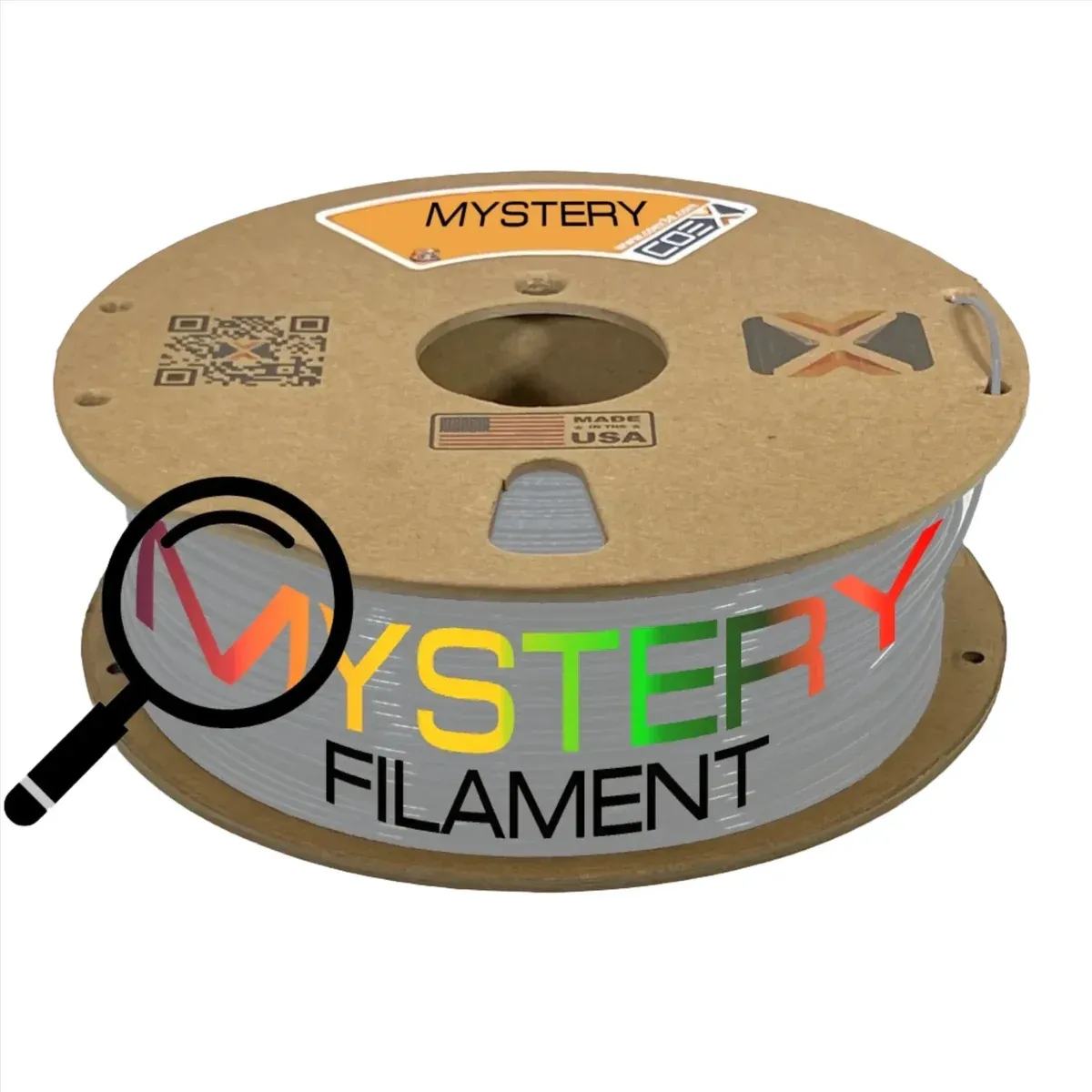
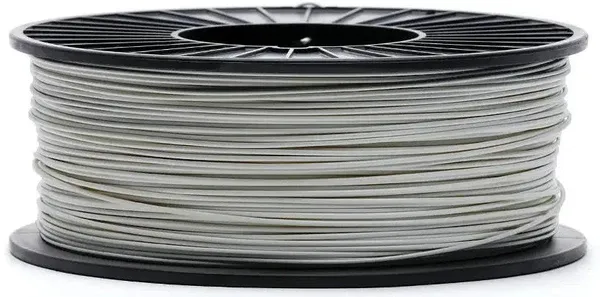
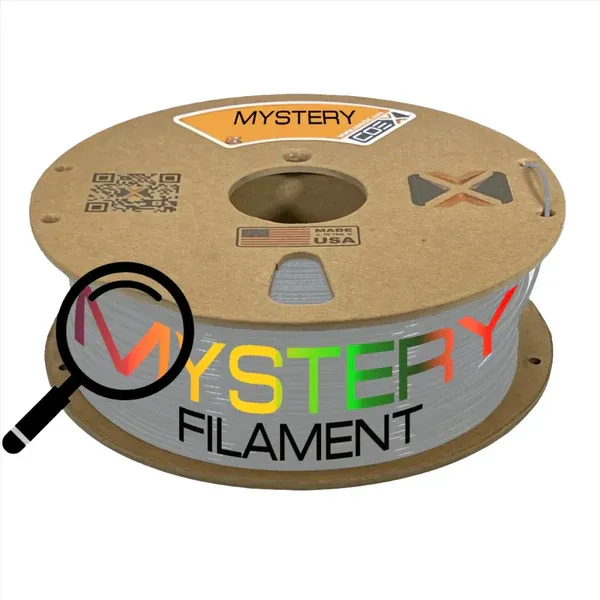
Our transition color ABS filament is the same high-quality ABS filament that our customers trust but in "mystery colors." These varying colors are the result of our changeovers from one of our standard colors to another during the production of our filament and cannot be reproduced. While supplies last. Items are not returnable or refundable due to color.
Note: These are not a rainbow filament. The color change in each spool will vary and be very gradual.
*This product is limited to availability as we make changeovers. If you cannot add it your cart, we are sorry, but we are out of stock.ABS+ filament is a thermoplastic 3d printing filament. ABS, which stands for Acrylonitrile Butadiene Styrene. Coex ABS + or ABS Prime is an engineering-grade material made from a higher-grade base resin which will provide an even stronger finished print than the standard Coex ABS filament. ABS is used by a variety of manufacturing industries for parts requiring structural integrity and detail and is commonly used in rapid prototyping and additive manufacturing environments to test product impact resistance and durability. This 3D printer filament comes in a variety of colors and is available in 1.75 and 2.85 MM in diameter, and comes in 500 g, 5 lbs, 15 lbs, and 1 kg.As opposed to PLA and PETG filament, ABS Prime is a bit more technical and may be more challenging for new 3D printing users, and requires the use of an enclosed 3D printer. ABS is a stiff 3D printing material that will be impact and heat-resistant. Common applications for ABS include end-use tools, moving parts, and parts that must withstand high mechanical stress.
Technical Printing Guide - COEX ABS Prime
1. Material Notes
Keep filament dry - store properly and dry before use
If needed, dry at 75°C for 3 hours or more
Enclosure is necessary
Use Z-offset slightly higher than PLA (+0.05mm)
Enable "Avoid crossing perimeters" to reduce stringing
Consider using the "Wipe while retract" option
Enable "Slow down for small perimeters."
Print outer walls slower for better quality
Use a minimum layer time of 30 seconds for small parts
Consider using "Extra Prime Amount" after retraction
2. Temperature Settings
Bed Temperature: 80-100°C
Wash the bed often for good adhesion - Use dish soap and rinse thoroughly to remove oils
Use bed adhesion products if necessary (gluestick, WELD3D)
Use brim for tall or large prints
Keep the ambient temperature stable
Extruder Temperature: 245-265°C
3. Basic Parameters
Nozzle
Layer Height
Line Width
Volumetric Speed
Temperature
0.4mm
0.2mm
0.42mm
14.0 mm³/s
250°C
0.6mm
0.3mm
0.62mm
31.5 mm³/s
255°C
0.8mm
0.4mm
0.82mm
56.0 mm³/s
260°C
1.0mm
0.5mm
1.02mm
87.5 mm³/s
265°C
4. Speed Settings
0.4mm Nozzle (Volumetric Speed: 14.0 mm³/s)
Line Type
Percentage
Speed
External Perimeter
50%
83.33 mm/s
Internal Perimeters
75%
125.00 mm/s
Infill
100%
166.67 mm/s
Top/Bottom
60%
100.00 mm/s
First Layer
30%
50.00 mm/s
0.6mm Nozzle (Volumetric Speed: 31.5 mm³/s)
Line Type
Percentage
Speed
External Perimeter
50%
84.68 mm/s
Internal Perimeters
75%
127.02 mm/s
Infill
100%
169.35 mm/s
Top/Bottom
60%
101.61 mm/s
First Layer
30%
50.81 mm/s
0.8mm Nozzle (Volumetric Speed: 56.0 mm³/s)
Line Type
Percentage
Speed
External Perimeter
50%
85.37 mm/s
Internal Perimeters
75%
128.05 mm/s
Infill
100%
170.73 mm/s
Top/Bottom
60%
102.44 mm/s
First Layer
30%
51.22 mm/s
1.0mm Nozzle (Volumetric Speed: 87.5 mm³/s)
Line Type
Percentage
Speed
External Perimeter
50%
85.78 mm/s
Internal Perimeters
75%
128.68 mm/s
Infill
100%
171.57 mm/s
Top/Bottom
60%
102.94 mm/s
First Layer
30%
51.47 mm/s
5. Retraction Settings
IMPORTANT: Set travel speed to the maximum your machine allows (200-500mm/s). Faster movements reduce filament oozing time, minimizing stringing.
Nozzle
Distance
Speed
Z-Hop
0.4mm
1.0-1.5mm
40mm/s
0.2mm
0.6mm
1.0-1.5mm
40mm/s
0.2mm
0.8mm
1.0-1.5mm
40mm/s
0.2mm
1.0mm
1.0-1.5mm
40mm/s
0.2mm
6. Cooling Settings
Cooling Configuration:
First Layer: 0% (fan off)
General Printing: 100% base fan speed
Bridges and Overhangs: 100% fan speed
Layers < 15 seconds: 100% fan speed
7. Troubleshooting Guide
Problem
Solution
Irregular extrusion
1. Dry the filament
2. Check the extruder
3. Reduce speed
Poor adhesion
1. Dry the filament
2. Use adhesive
3. Adjust the first layer
Stringing
1. Dry the filament
2. Adjust retraction
3. Increase travel speed
4. Check temperature
PLEASE NOTE: These printing parameters are initial recommendations based on our experience. They may need adjustment depending on your specific 3D printer, environmental conditions, and the geometry of the part you are printing. Use these settings as a starting point and fine-tune them according to your specific needs.
.docs-container {
margin: 2em 0;
}
.docs-section-wrapper {
margin-bottom: 1.5em;
padding-bottom: 1.5em;
border-bottom: 1px solid #e0e0e0; /* Simple line separator */
}
/* Remove the last separator line for a clean finish */
.docs-container .docs-section-wrapper:last-child {
border-bottom: none;
margin-bottom: 0;
padding-bottom: 0;
}
.docs-accordion summary {
cursor: pointer;
padding: 0.5em 0;
list-style: none;
display: flex;
justify-content: center;
align-items: center;
}
.docs-accordion summary::-webkit-details-marker {
display: none;
}
.docs-title {
text-align: center;
}
.docs-title h3 {
margin: 0;
font-weight: bold;
display: inline;
}
.docs-accordion summary::after {
content: '▼';
font-size: 0.8em;
margin-left: 0.5em;
transition: transform 0.2s;
flex-shrink: 0;
}
.docs-accordion[open] > summary::after {
content: '▲';
}
.docs-content {
padding: 1em 0 0 0;
}
.docs-content-paper {
max-width: 850px;
margin: 1em auto;
padding: 2em;
border: 1px solid #ddd;
box-shadow: 0 0 10px rgba(0,0,0,0.05);
background: white;
}
/* --- NEW: Blue Link Styling --- */
.docs-container a {
color: #005BD3; /* Standard Shopify link blue */
text-decoration: none;
font-weight: bold;
}
.docs-container a:hover {
text-decoration: underline;
}
.docs-main-link, .docs-download-link {
display: block;
text-align: center;
}
.docs-main-link {
margin-bottom: 1.5em;
}
.docs-download-link {
padding-top: 0.75em;
}
/* --- Mobile Responsive Fixes --- */
@media (max-width: 768px) {
.docs-content-paper {
padding: 1em;
overflow-x: auto;
}
.docs-title h3 {
font-size: 1.1em;
}
}
Coex 3D Filament Slicer Profiles
CX09 ABS Prime Technical Data Sheet
.datasheet-table { border-collapse: collapse; width: 100%; margin-bottom: 1em; }
.datasheet-table th, .datasheet-table td { border: 1px solid #cccccc; padding: 8px; text-align: left; }
.datasheet-table th { background-color: #f2f2f2; }
.datasheet-h4 { font-family: sans-serif; }
Technical Data Sheet: CX09 ABS PRIME SERIES 3D PRINTING FILAMENT
TDS Rev 2.0
BASE RESIN: LG Chem Ltd. ABS High Impact
Physical Properties
PropertyStandardUnitTypical Value
Specific Gravity - DensityASTM D792g/cm³1.05Melt Density @220°C, 10KGASTM D1238g/10 min22UL Flammability Class. @1.14mmUL 94N/A94HB
Mechanical Properties
PropertyStandardUnitTypical Value
Tensile Yield StrengthASTM D638MPa49Tensile ModulusASTM D638MPa2350Tensile ElongationASTM D638%30Flexural StressISO 178MPa78Notched Izod ImpactASTM D256J/m225Shrinkage Rate < 1%ASTM D955mm/mm0.40 - 0.70%
Thermal Properties
PropertyStandardUnitTypical Value
Glass Transition Temperature (Tg)DSC°C95Heat Distortion Temp @ 0.45MPaASTM D648°C85Decomposition TemperatureASTM 3418°CN/A
SPECIFICATIONS
Filament Size:1.75mm(in)2.85mm(in)
MIN Diameter:1.72mm0.0677 in2.79mm0.1098 inMAX Diameter:1.78mm0.0701 in2.91mm0.1146 inTolerance+/- .03mm+/- 0.0012 in+/- .06mm+/- 0.0024 in
CERTIFICATIONS
ROHS compliant to (2011/65/EU) Annex II, recasting 2002/95/EC
NSF/ANSI 51 Food Equipment Materials
UL/C-UL Certified Yellow Card E302314
Printed Specimen Conditions
Printer:Open Source FDM/FFFNozzle:0.4mmLayer Height:0.25mmInfill:100%, +/-45°Extrusion Temp:240°CBed Temp:90°CSpecimen Orientation:XY FlatUnannealed
Disclaimer: The technical data contained on this data sheet is furnished without charge or obligation and accepted at the recipient's sole risk. This data should not be used to establish specifications limits or used alone as the basis of design. The data provided is not intended to substitute any testing that may be required to determine fitness for any specific use.
Download TDS (PDF)
CX09 ABS Prime Safety Data Sheet
.msds-table { border-collapse: collapse; width: 100%; margin-bottom: 1em; }
.msds-table th, .msds-table td { border: 1px solid #cccccc; padding: 8px; text-align: left; vertical-align: top; }
.msds-table th { background-color: #f2f2f2; }
.msds-section { margin-bottom: 1.5em; }
.msds-section h4 { font-family: sans-serif; border-bottom: 1px solid #eee; padding-bottom: 0.3em; }
.msds-subsection { display: flex; flex-wrap: wrap; }
.msds-subsection .label { font-weight: bold; width: 200px; flex-shrink: 0; }
.msds-subsection .data { flex-grow: 1; }
Material Safety Data Sheet: CX09 ABS PRIME SERIES 3D PRINTING FILAMENT
MSDS Rev 1.0
BASE RESIN: LG ABS HI121H
1. Identification of the substance/preparation and of the company
1.1 Trade name:Coex ABS 3D printer filament
1.2 Use of the product:3D printer filament, thermoplastic polymer
1.3 Supplier:Coex660 Corporate WAYPulaski, WI 54162Phone: (920) 757-1055
2. Hazards identification
2.1 Classification:Combustible Dust
2.2 Special advice on hazards:May form combustible dust concentrations in air. While this product may not be a combustible dust as sold, further processing or handling may form combustible dust concentrations in air.
3. Composition / information on ingredients
3.1 Chemical characteristics:
CAS #Hazardous ComponentsConcentration
9003-56-9Styrene Acrylonitrile Copolymer95~100%
-Typical Stabilizer0-3%
-Typical Lubricant0-3%
4. First-aid measures
4.1 On skin contact:In case of contact with molten polymer immediately cool the skin with cold water. Medical aid may be required to remove adhering material and for treatment of burns.
4.2 After inhalation:Remove from exposure and move to fresh air immediately. If not breathing, give artificial respiration. If breathing is difficult, give oxygen. Get medical aid.
4.3 On ingestion:If swallowed, wash out mouth with water provided person is conscious. Call a physician.
4.4 On eyes contact:In case of contact, immediately flush eyes with copious amounts of water for at least (15) minutes.
5. Fire-fighting measures
5.1 Suitable fire extinguishing media:Water spray and foam. Water is the best extinguishing medium.
5.2 Special exposure hazards:Emits toxic fumes under fire conditions. Approved positive pressure demand breathing apparatus (SCBA) and protective clothing should be used for all fires.
5.3 Special protective equipment:Self-contained breathing apparatus
5.4 Remark:Carbon dioxide and carbon monoxide generated when the material burns. Combustible Dust may form during material transfer. Estimated Dust Explosion Class = ST2; Kst estimated (bar.m/s): >200 -
6. Accidental release measures
6.1 Personal precautions:Use suitable protective clothing. Avoid eye contact and inhalation of dusts. Keep ignition sources away.
6.2 Methods for cleaning up:Vacuum or sweep up material and place into a suitable disposal container.
7. Handling and storage
7.1 Handling:Avoid contact with molten polymer. Avoid generation of dust and electrostatic charge.
7.2 Storage:Protect against moisture. Store cool and keep packaging closed when not in use. Avoid sources of ignition.
8. Exposure controls/ personal protection
8.1 Technical safety measures:Use with adequate ventilation. Minimize dust generation and accumulation as combustible dust mixtures may be formed.
8.2 Personal safety equipment:Use adequate safety equipment, e.g. protective clothing, eye protection glasses, heat protection gloves. In case of dust formation wear mask with particle filter.
8.3 Work hygiene:No eating or drinking during working. Avoid contact of hot material with the skin. Avoid breathing dust and vapors.
9. Physical and chemical properties
9.1 Form:Spool
9.2 Color:Various
9.3 Odor:Almost Odorless
9.4 Melting Temperature:250 °C
9.5 Oxidizing properties:Not self-igniting / flammable
9.6 Explosions limits:Class = ST2
9.7 Density:1.05 g/cm³
9.8 Solubility in water:Insoluble
10. Stability and reactivity
10.1 Stability:The product is stable at recommended storage conditions.
10.2 Conditions to be avoided:Stable under recommended conditions of storage and handling.
10.3 Substances to be avoided:No special recommendations.
10.4 Hazardous decomposition products:Processing fumes evolved at recommended processing conditions may include trace levels of low molecular weight hydrocarbon fragments, carbon dioxide, carbon monoxide and Irritating fumes and gases.
11. Toxicological information
11.1 Local irritation:No data available.
11.2 Other remarks:No data available.
12. Ecological information
12.1 Ecological info:This product is not classified as environmentally hazardous. However, this does not exclude the possibility that large or frequent spills can have a harmful or damaging effect on the environment.
12.2 Biological degradation:No data available.
12.3 Bioaccumulation:This product will not readily bioaccumulate due to its insolubility in water.
13. Disposal considerations
13.1 Product:Chemical waste generators must determine whether a discarded chemical is classified as a hazardous waste. US EPA guidelines for the classification determination are listed in (261) CFR Parts (261.3). Additionally, waste generators must consult state and local hazardous waste regulations to ensure complete and accurate classification. RCRA P-Series: None listed. RCRA U-Series: None listed.
13.2 Uncleaned packaging:Packaging material has to be emptied completely and disposed in accordance with the regulations. Packaging can be recycled if not contaminated.
14. Transport information
14.1 Transport regulations:Not classified as hazardous under transport regulations DOT, ICAO/IATA, IMDG/GGVSee, ICAO/IATA
15. Regulatory information
15.1 EPA regulations: This material meets the EPA 'Hazard Categories' defined for SARA Title III Sections 311/312 as indicated:
Acute (immediate) Health Hazard: No
Chronic (delayed) Health Hazard: No
Fire Hazard: Yes
Sudden Release of Pressure Hazard: No
Reactive Hazard: No
16. Other information
This data is based on the current state of our information and experience. This safety data sheet describes our product in terms of safety requirements. Preceding data is not applicable as a warranty of product properties. It is the responsibility of the recipient to observe the existing legal regulations for the use of this product.
Disclaimer: The safety data contained on this data sheet is furnished without charge or obligation and accepted at the recipient's sole risk. This data describes our product in terms of safety requirements. The data provided is not applicable as a warranty of product properties. It is the responsibility of the recipient to observe the existing legal regulations for the use of this product.
Download SDS (PDF)
CX09 ABS Prime Yellow Card
.datasheet-table { border-collapse: collapse; width: 100%; margin-bottom: 1em; }
.datasheet-table th, .datasheet-table td { border: 1px solid #cccccc; padding: 8px; text-align: left; }
.datasheet-table th { background-color: #f2f2f2; }
.datasheet-h4 { font-family: sans-serif; }
.group-header { background-color: #e0e0e0; font-weight: bold; }
Yellow Card Sheet: CX09 ABS PRIME 3D PRINTING FILAMENT
YELLOW CARD Rev 1.0
Flammability
Flame RatingValueTest Method
1.5 mm, ALLHBUL 943.0 mm, ALLHBUL 943.0 mm, ALLHB40IEC 60695-11-10, -201.5 mm, ALLHB75IEC 60695-11-10, -20
Electrical
PropertyValueTest Method
Hot-wire Ignition (HWI)1.5 mmPLC 3UL 746A3.0 mmPLC 3High Amp Arc Ignition (HAI)1.5 mmPLC 0UL 746A3.0 mmPLC 1Comparative Tracking Index (CTI)PLC 0UL 746ADielectric Strength27 kV/mmUL 746AHigh Voltage Arc Tracking Rate (HVTR)PLC 2UL 746AVolume Resistivity1.0E+15 ohm-cmASTM D257, IEC60093Arc ResistancePLC 6ASTM D495
Thermal
PropertyValueTest Method
RTI Elec1.5 mm95.0 °CUL 746B3.0 mm100.0 °CRTI Imp1.5 mm95.0 °CUL 746B3.0 mm100.0 °CRTI Str1.5 mm95.0 °CUL 746B3.0 mm100.0 °CDimensional Change0.0%ASTM D1042, ISO 2796
Disclaimer: The technical data contained on this data sheet is furnished without charge or obligation and accepted at the recipient's sole risk. This data should not be used to establish specifications limits or used alone as the basis of design. The data provided is not intended to substitute any testing that may be required to determine fitness for any specific use.
Download Yellow Card (PDF)
Featured Products





Easy returns
Free 30-day returns with quick refunds or easy exchanges and no stress.
Free shipping
Enjoy fast, free shipping on all orders, no minimum, no hidden fees.
Secure payment
Your information is protected with encrypted checkout and trusted payment methods.